Best ATS for Executive Search Firms in 2026: 5 Top Options

ATS comparison

Chris Allen
TL;DR
Executive search needs three things most ATS tools get wrong: confidential multi-client pipelines, relationship tracking that stays useful for years, and outbound sourcing as the default rather than an add-on.
Happlicant delivers all three in a combined ATS and CRM built specifically for solo and small-team practitioners, with transparent pricing and same-week setup, no enterprise sales process and no months of configuration before you can run a search.
Executive search breaks most ATS software for one simple reason: the software was built for a different job. A corporate ATS is designed to sort inbound applications for one employer over a four-to-six-week cycle. Executive search is the opposite on every axis.
You're sourcing outbound instead of waiting for applicants, running confidential mandates for multiple clients at once, and a single search can run nine to eighteen months from kickoff to placement.
Most guides in this category point you toward expensive, single-purpose platforms built for large retained search firms with a dozen consultants and a six-figure software budget. That's not most executive search practices. The majority are solo recruiters or boutique firms of two to five people who need the same workflow without the enterprise price tag or the months-long implementation.
That's who Happlicant is built for, and this guide walks through why, along with an honest look at where the bigger platforms fit instead.
Why executive search breaks a standard ATS
Three assumptions are baked into almost every mainstream ATS, and all three are wrong for retained search.
Assumption 1: candidates come to you
Most ATS platforms are built around inbound applications. Someone applies, the system parses their CV, a recruiter screens them. Executive search rarely works this way. The right candidate for a CFO mandate isn't applying anywhere. They're currently employed, not looking, and have to be found and approached directly.
A platform that treats sourcing as a secondary feature will fight you on the most important part of the job.
Assumption 2: one employer, one pipeline
A corporate ATS assumes every candidate is being evaluated for the same company. A search firm runs mandates for multiple clients at once, sometimes in the same industry.
Without real multi-client architecture, firms end up bolting on spreadsheets and manual tagging just to stop mandates from bleeding into each other, which is exactly the admin overhead a proper ATS is supposed to remove.
Assumption 3: short pipelines, short memory
Most ATS tools are optimized for a 30 to 90 day hiring cycle. A retained search mandate typically runs nine to eighteen months, and the value of a search firm's candidate database compounds over years, not weeks.
Someone who wasn't right for a search in 2023 may be exactly right for a different mandate in 2026, if the relationship history is still easy to find and use.
There's a fourth factor that doesn't break the software but does break client trust if it's ignored: confidentiality. Many searches run before the client company is named publicly.
A platform that exposes the client name in candidate-facing emails, or in shared reports, creates real reputational and contractual risk.

What this means for the software you choose
A combined ATS and CRM, so client relationships and candidate history live in one place instead of two disconnected systems
Genuine multi-client pipeline support, not workarounds bolted onto a single-employer data model
Outbound sourcing built into the core workflow, not gated behind an extra-cost add-on
Long-term candidate relationship tracking that stays searchable and useful years later
Transparent pricing so boutique and solo practices can budget without a sales call
A system you can actually be running searches in within days, not after a multi-week implementation
Try Happlicant for free
Get access to the fastest-growing agency & independent recruiter software. CRM, ATS and much more to run and grow your business more efficiently.
Why Happlicant is built for this
Happlicant addresses every one of those requirements directly, and it does so for the segment of executive search that most platforms in this category ignore: the solo recruiter and the boutique firm.
One system for candidates and clients
Happlicant’s ATS and CRM are the same database. Candidate history, client relationships, and mandate status all live in one place. There’s no separate spreadsheet or second tool needed to track who’s working on what for which client.
For a firm running several confidential searches at once, that single source of truth is the difference between a clean process and a chaotic one.
Built for relationship-driven, long-cycle search
Candidate notes, communication history, and pipeline stages stay attached to a candidate’s record indefinitely.
A senior candidate who wasn’t right for a mandate two years ago is exactly as easy to find and re-engage as someone added yesterday, which matters enormously in a field where the same candidate pool resurfaces across multiple searches over a career.
Outbound sourcing without the enterprise price tag
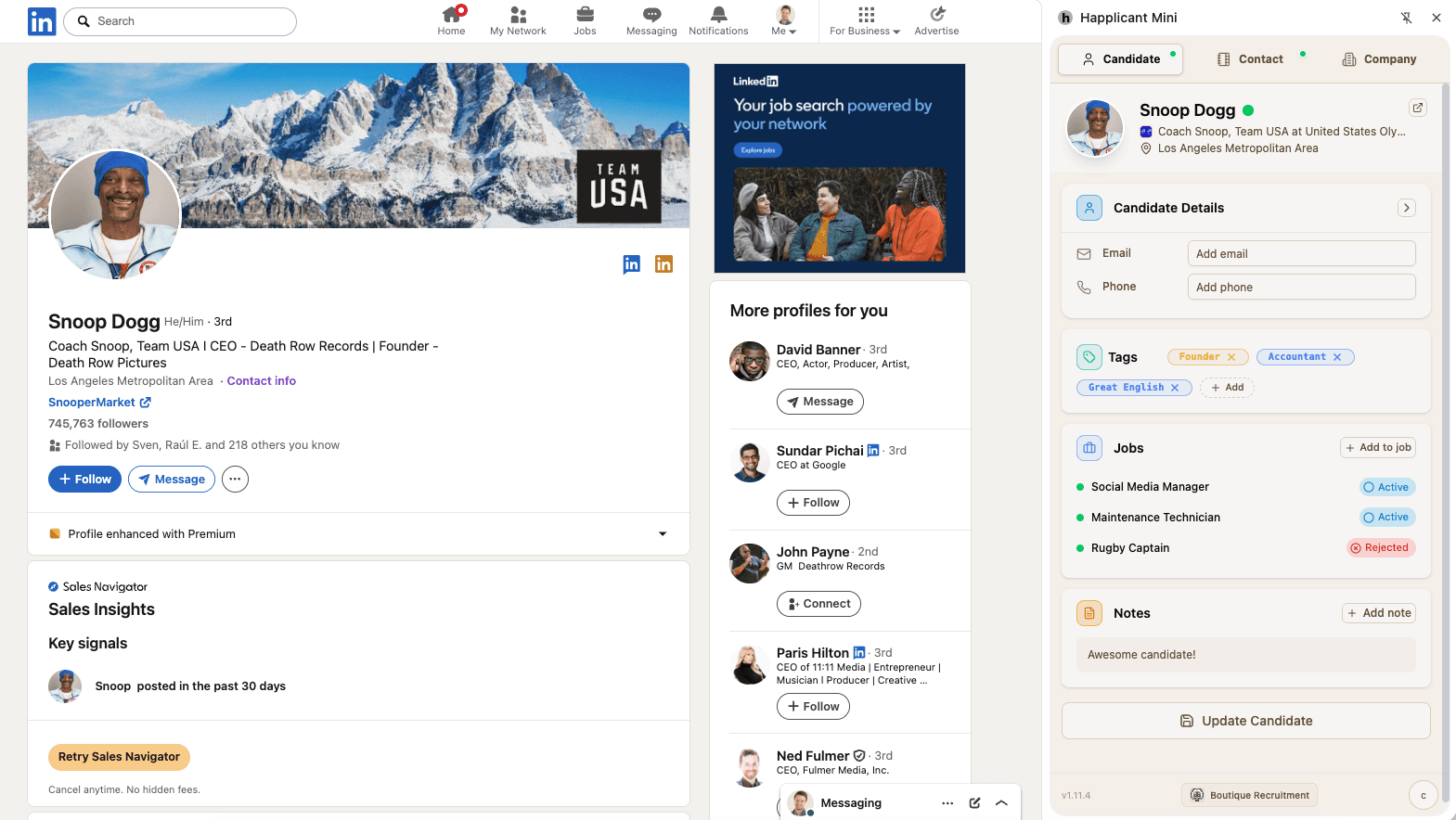
The LinkedIn Chrome sourcing extension lets you move a candidate from a LinkedIn search directly into your pipeline in one click, no manual data entry, no separate sourcing subscription.
For solo and boutique firms whose search model is genuinely outbound and relationship-led rather than database-scale sourcing, this covers the workflow that actually matters day to day, without paying for sourcing infrastructure built for a 50-consultant firm.
Set up in days, not months
There’s no lengthy implementation process and no enterprise sales cycle. Most users are running real searches the same week they sign up.
For a boutique firm, that means no lost months between deciding to switch platforms and actually being productive on one.
Pricing that doesn’t punish small teams
Happlicant is $75 per user per month on the monthly plan, or $69 per user per month billed quarterly, with no per-seat cost creep as the practice grows from one recruiter to three.
An enterprise plan with unlimited users is available at a flat fee for larger operations, priced on request. Compare that to platforms in this category that require a full sales conversation before revealing a number.
For a cost-conscious boutique firm, that transparency alone removes a real source of friction.

Get access to the fastest-growing agency & independent recruiter software. CRM, ATS and much more to run and grow your business more efficiently.
How Happlicant compares to the rest of the category
The other platforms commonly mentioned for executive search are worth knowing about, mainly because they show who they’re built for, and it usually isn’t the solo or boutique firm.
Clockwork
Clockwork is structured exclusively around retained search as its own object, which makes sense for a large practice running search as its entire business.
For a smaller firm, that structure becomes rigidity. It’s a heavier, more specialized system than most boutique or solo practitioners need, and it isn’t built for firms that blend search with other placement types.
Crelate
Crelate is genuinely configurable for senior-level, relationship-driven search, and it’s a reasonable option if deep customization is the priority. The trade-off is real setup time.
This isn’t a platform you’re productive in within an afternoon, which works against the speed boutique firms usually need when switching systems.
Invenias
Invenias integrates closely with Microsoft tools, which is useful specifically for firms already living inside Outlook and Office 365.
Outside of that environment, it offers little advantage, and its flexibility can lead to inconsistent processes across a small team without careful configuration.
Loxo
Loxo’s native sourcing database is strong for firms doing high-volume outbound sourcing. Its entry Core plan runs $149 per user per month billed annually, with Professional now published at $199 per user per month (billed annually) for the full AI sourcing suite, and Enterprise priced only through a sales conversation (Loxo pricing page).
There’s no free tier anymore (only a 7-day trial), and the entry Core plan starts at $149/user/month - a real cost from day one for a solo practitioner. Loxo is also built to serve a broad range of recruiting models, from contingency staffing to executive search, so its workflows are less specifically structured around the realities of a retained mandate than a tool built for that purpose.
Comparison table
Platform | Best For | Pricing | Setup Time | Built For Boutique / Solo Firms |
|---|---|---|---|---|
Happlicant | Solo and boutique executive search firms | $75/user/mo monthly, $69/user/mo quarterly | Days | Yes, purpose-built |
Clockwork | Large dedicated retained search firms | Custom quote | Weeks | No, enterprise-oriented |
Crelate | Firms wanting deep configurability | From $85/user/mo (annual); $119 Business; custom for upper tiers | Weeks | Partial |
Invenius | Microsoft-based environments | Custom quote | Weeks | No |
Loxo | High-volume outbound sourcing | $149/user/mo annual (Core); $199/user/mo annual (Professional); custom quote for Enterprise | Days to weeks | No, generalist |
The bottom line
If you’re running a large retained search practice with the budget and team to justify a dedicated enterprise system, Clockwork or Invenias may be worth the investment and the implementation time.
But most executive search practitioners aren’t running a 15-consultant firm. They’re a solo recruiter or a small boutique team who need the same workflow fundamentals, multi-client pipelines, outbound sourcing, long-term relationship tracking, and confidentiality, without enterprise pricing or a multi-month rollout.
That’s the gap Happlicant fills. It’s the ATS built for the executive search practitioner who needs to be running searches this week, not after a quarter of implementation.
Book a call to start your free trial and see whether Happlicant fits how your practice actually runs.
Frequently Asked Questions:
Is Happlicant suitable for executive search, or only general recruiting?
Why can't executive search firms just use a standard ATS?
What is the best ATS for retained search firms in 2026?
What is the best CRM for headhunters in 2026?
What is the best ATS for executive search firms in 2026?

See Happlicant's software in action
Jump on a quick demo call to see how Happlicant's ATS/CRM can save you time and help you grow your agency.