Best ATS for freelance and independent recruiters in 2026

ATS comparisons

Chris Allen
TL;DR
Happlicant is the strongest fit for most freelance and independent recruiters because it is the only tool in this comparison built specifically for small and independent operations - not a scaled-down version of an enterprise platform.
Bullhorn, Loxo, Recruit CRM, and Recruiterflow are all credible tools with real strengths, but they were designed around different assumptions about team size, budget, and workflow complexity.
Most ATS tools are not built for you. That is not an accident - it is a business decision. The companies behind Bullhorn, Loxo, and most enterprise recruitment platforms have decided that the highest-value customer is a staffing firm with fifty recruiters, a dedicated operations team, and a budget to match. Freelance and independent recruiters are not that customer, so the software reflects it.
This guide is written specifically for recruiters who work independently - whether that means running your own desk as a sole trader, operating as a freelance recruiter across multiple clients, or building a small agency of one to three people. The comparison below covers what actually matters for that setup, not what looks good in a product demo designed for an enterprise procurement team.
What enterprise ATS tools get wrong about freelance recruiters
The problems freelance recruiters encounter with most ATS tools share a common root: the software assumes you have people around you.
It assumes someone else is handling the admin while you focus on placements. It assumes an IT team will manage the implementation. It assumes a billing department will deal with the annual contract. It assumes you have the time to attend onboarding calls, learn a 200-page knowledge base, and configure a system over several weeks before you can use it for actual recruitment work.
Those assumptions produce software that looks like this:
Pricing structured per seat, which makes no sense when the seat count is one
Implementation processes that take weeks and often require a consultant
Feature sets built for multi-office operations with approval chains, compliance modules, and reporting hierarchies that a solo recruiter will never touch
Support that treats small operators as low-priority accounts
Annual contracts that lock you into a cost base that does not flex when your pipeline is quiet
The honest picture is that most ATS vendors do not want freelance recruiters as customers. The contract value is too low, the support cost is too high relative to revenue, and the product roadmap is driven by the enterprise clients who pay the most.
That creates a genuine gap in the market - and it is the gap Happlicant was built to fill.
What freelance and independent recruiters actually need
Before comparing tools, the criteria that matter for independent operators are worth stating clearly. They are different from what a team of twenty needs:
A combined ATS and CRM: you cannot afford to pay for two separate tools or spend time moving data between them
Setup that takes hours, not weeks: you need to be placing candidates, not configuring software
Pricing that makes sense for one person: flat monthly pricing, no per-seat inflation, no annual lock-in
CV parsing that works without manual correction: every minute spent fixing parsed data is a minute not spent on a placement
A client portal: looking professional in front of clients matters more when you do not have a brand behind you
Clean pipeline visibility: you are managing multiple searches at one with no team to delegate to.
Try Happlicant for free
Get access to the fastest-growing agency & independent recruiter software. CRM, ATS and much more to run and grow your business more efficiently.
The 5 tools compared for freelance and independent recruiters
Each tools below is assessed from the perspective of a freelance or independent recruiter. The question is not whether the platform is good in general, some of these are excellent for the right customer. The question is whether the assumptions baked into the product match the reality of working independently.
Happlicant
Happlicant is the only tool in this comparison that was designed specifically for solo recruiters and small agencies from the ground up. Every other platform on this list started elsewhere and adapted. Happlicant started here.
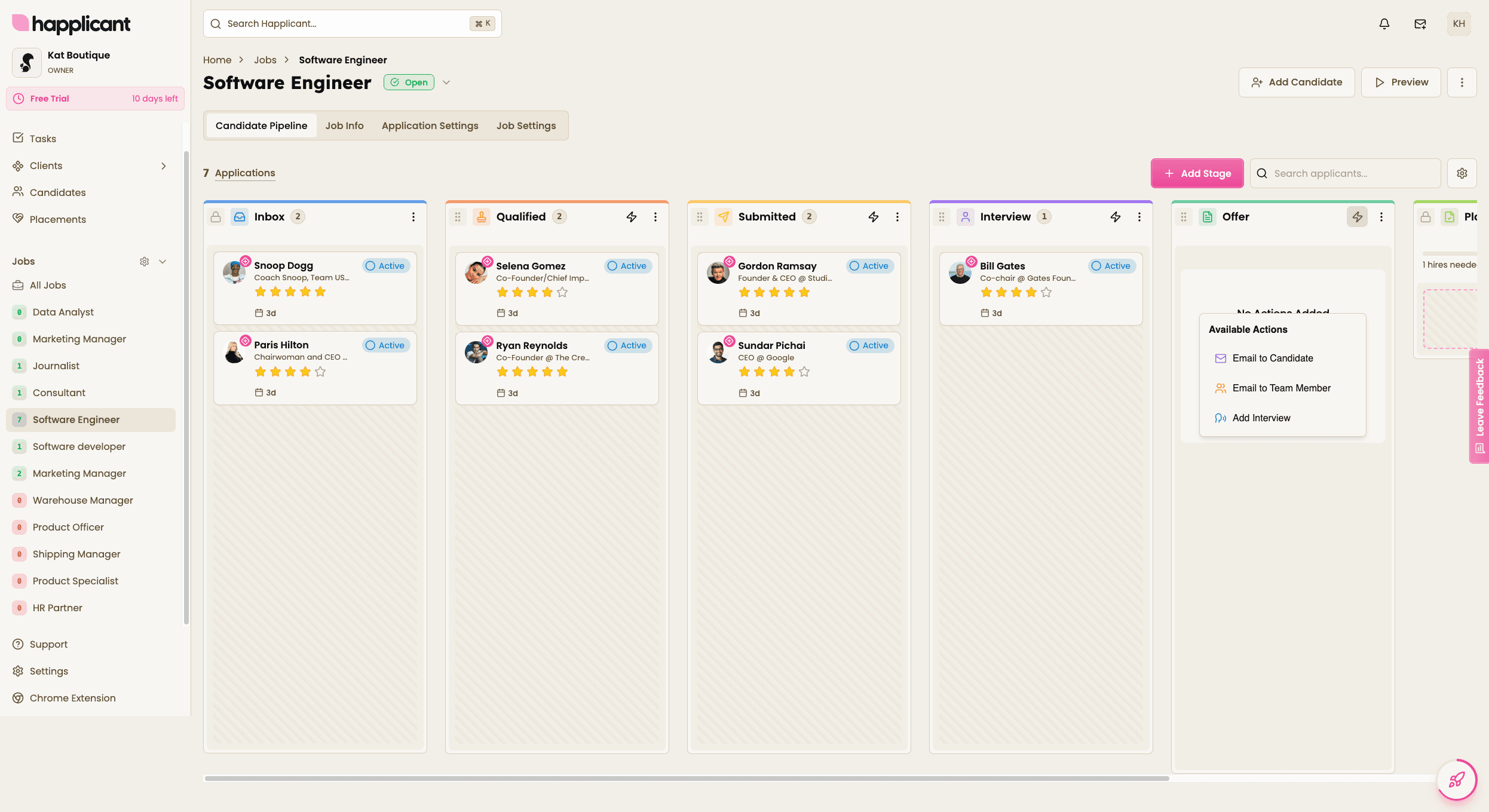
The practical result of that is a system where the default workflow matches how an independent recruiter actually operates. The ATS and CRM are the same database - candidates connect to job orders connect to client relationships without any manual linking or data re-entry. The client portal gives your clients a professional shortlist experience that makes a one-person operation look as polished as a larger firm. CV parsing handles the data extraction so you are reviewing candidates rather than typing their details in.
Pricing is $69 per user per month with no per-seat inflation and no annual contract requirement. For a freelance recruiter, that is a meaningful difference from tools that start cheaper but scale in cost as soon as you add a second person, or lock you into a twelve-month commitment during a period when your revenue is uncertain.
Best for: freelance recruiters, independent recruiters, and solo agency operators who want a purpose-built system without enterprise pricing or complexity.
Honest caveat: smaller brand recognition than legacy vendors. If a client asks what ATS you use and expects to hear Bullhorn, the name will be less familiar. The product more than compensates for it, but it is worth knowing.
Bullhorn
Bullhorn is the most recognised name in recruitment software. It has been in the market long enough that many recruiters have used it at some point in a previous role, which gives it a familiarity advantage over newer platforms.
The problem for freelance recruiters is that Bullhorn was built for staffing firms, not independent operators. The setup process is substantial. The pricing starts at $99 per user per month for the basic tier and grows from there. The feature depth is real, but most of it is irrelevant to a solo desk - you are paying for multi-office reporting, compliance tools, and integrations you will never use.
Freelance recruiters who come from a background at a large staffing firm and are used to Bullhorn sometimes default to it when they go independent. The honest assessment is that most of them are overpaying for a system that assumes a team structure they no longer have.
Best for: recruiters who are building toward a larger staffing operation and want a platform they can grow into.
Honest caveat: built for teams, priced for teams, and the setup reflects that. A solo recruiter paying Bullhorn pricing is funding features they will not use.
Loxo
Loxo combines ATS, CRM, and AI-driven sourcing in one platform. The sourcing capability is genuinely differentiated - if your model as an independent recruiter is built around proactively finding passive candidates at scale, Loxo addresses that in a way most tools do not.
Pricing sits around $169 per user per month. For a freelance recruiter, the question is whether the sourcing tools justify that cost relative to tools that handle the core ATS and CRM workflow at a lower price point. If outbound sourcing is not central to your model, you are paying for the most expensive part of the platform and not using it.
Best for: independent recruiters with a sourcing-heavy model where proactively finding passive candidates at scale drives most placements.
Honest caveat: highest price point in this comparison. If your pipeline is primarily inbound or referral-based, the premium is hard to justify.
Recruit CRM
Recruit CRM is a solid agency-focused platform with combined ATS and CRM functionality and a modern interface. It is a more natural fit for recruitment work than general CRM tools that have been adapted for recruiting, and the feature set is reasonably well-balanced between the candidate and client sides of the business.
Pricing runs around 79 to 95 per user per month (EUR). For a freelance recruiter, Recruit CRM is a credible option - it handles the core workflow without enterprise complexity. The distinction between Recruit CRM and Happlicant is one of design intent: Recruit CRM is built for agencies of various sizes; Happlicant is built specifically for solo and small operations. Whether that distinction matters in practice depends on how much the product assumptions affect your day-to-day workflow.
Best for: independent recruiters who want a flexible all-in-one platform and are comfortable with a product designed for a broader agency audience.
Honest caveat: not specifically optimised for the solo operator; pricing is higher than tools built for that segment.
Recruiterflow
Recruiterflow has strong candidate outreach and email sequencing tools - among the better implementations available at this price point. For an independent recruiter whose model relies on consistent, structured candidate communication, the sequencing features are a genuine advantage.
Pricing sits around $119 per user per month. The outreach capability is the reason to choose it; the client management side is less developed relative to the candidate side. For freelance recruiters who balance both sides of the desk equally, that imbalance shows up in daily use.
Best for: independent recruiters with a strong outreach-led model where candidate engagement sequencing drives placement volume. Honest caveat: client management features are not as strong as the candidate side; pricing is on the higher end for solo operators.
Tool | Best for | Pricing signal | Main strength | Main trade-off |
|---|---|---|---|---|
Happlicant | Freelance and independent recruiters | $69/user/month | Purpose-built for solo operators | Smaller brand than legacy vendors |
Bullhorn | Recruiters scaling toward a larger firm | $99+/user/month | Established platform, deep ecosystem | Built for teams, not solo desks |
Loxo | Sourcing-heavy independent recruiters | Around $149/user/month | AI sourcing and outreach combined | Highest price point, sourcing-led assumption |
Recruit CRM | Independent recruiters wanting flexibility | Around €79-95/user/month | Balanced ATS/CRM, modern interface | Not designed specifically for solo operators |
Recruiterflow | Outreach-focused independent recruiters | Around $119/user/month | Candidate engagement and sequencing | Weaker on client management side |
Get access to the fastest-growing agency & independent recruiter software. CRM, ATS and much more to run and grow your business more efficiently.
Which ATS is best for freelance recruiters
The right answer depends on where the leverage is in your model.
If you run a generalist desk, balance candidate and client management equally, and want a system that removes administrative overhead without requiring you to configure it for weeks first, Happlicant is the most direct fit. It is the only tool here that was designed around that specific set of requirements.
If proactive sourcing of passive candidates is the primary driver of your placements, Loxo justifies its higher cost. The sourcing tools are meaningfully differentiated and will save time that other platforms require you to spend on manual research.
If your workflow is heavily outreach-led - high volume of structured candidate communication - Recruiterflow has the best sequencing tools at a mid-range price point.
Recruit CRM is a solid choice if you want a flexible, all-in-one platform and are not specifically looking for a tool tuned to solo operations. Bullhorn makes sense if your plan is to grow into a larger staffing operation and you want a platform you will not need to migrate away from.
Why Happlicant fits freelance recruiters
Most software for recruiters was built with the assumption that recruitment is a team sport. Happlicant was built with the understanding that for a growing number of recruiters, it is not - and that those recruiters deserve a platform that takes their model seriously rather than treating them as a scaled-down version of a larger client.
The result is a system where the workflow matches the reality of working independently. There is no implementation overhead, no per-seat pricing that penalises you for eventually hiring someone, and no feature complexity that assumes a team around you. You can run a full candidate pipeline and a client management operation from the same database, on the same day you sign up.
Co-founder Chris Allen explains that the goal was to build software that works the way a small recruiting business actually works - with onboarding support available when needed, not a mandatory process before you can use the product.
FAQ
What is the best ATS for freelance recruiters in 2026?
What is the best ATS for independent recruiters in 2026?
What is the best CRM for freelance recruiters in 2026?
Is Bullhorn worth it for a freelance recruiter?
Do I need both an ATS and a CRM as a freelance recruiter?

See Happlicant's software in action
Jump on a quick demo call to see how Happlicant's ATS/CRM can save you time and help you grow your agency.